Showing posts with label trees. Show all posts

Tuesday, September 18, 2012

Follow Us

School Campus Tree Planting - A Narrative Report

    It was given to me two weeks ago to be finished. I haven't taken the time to do so. I don't feel like doing it. Besides, the previous weeks was a busy weeks. A lot of activities has come.
    I was in the mood of thinking what to say and this was my finished product. I hope you like it. It's my Narrative Report about the Tree Planting that we just did in our school. I was the one tasked to do the Narrative Report since no one wants to accept the job.
   Enjoy reading.. Feel free to pattern your work from here. Just don't plagiarize.. ):
trees
TREE PLANTING


     One thing I found out while writing about this Narrative Report - even if everything that you have written came from your own mind and idea, when you check it through plagiarism checker software, there are times that you will find your work to be unoriginal. I know because I have check my work once, and it turns out that my idea and way of talking has similarities from the other works. Maybe we have one or two sentences that are almost the same, but I am 100% sure that every word and every idea on this Report has come from my own bank of words and phrases. But still, to make sure, I have rephrase my work until I am assured that it will turn out to be original.. **Better safe than sorry**

(^-^)


Tuesday, February 2, 2010

Follow Us

Coffee and Heart disease


The health effects of coffee are still being disputed, and many studies have examined the relationship between coffee consumption and certain medical conditions. Some studies have suggested that the consumption of coffee lowers the risk of certain diseases but may have negative effects as well, especially when excessive. Well, if coffee is taken excessively, there is no doubt that negative effect may encounter. Just like the old saying…everything that is excessive or lacked of is bad…everything should be enough. *_* (Am I so defensive?? :D)

Many studies have been conducted concerning the relationship between drinking coffee and heart disease.

Coffee is also associated with the heart disease. Some said that it affects heart beats thus leads to heart disease. So there are studies regarding this issue. And many of the test results were conflicting. Several reports stated that there was no connection between drinking coffee and heart disease. However, there are two studies that reported out that there was a direct connection between drinking coffee and getting heart disease. One of the problems with coffee is that it contains caffeine. Caffeine is a stimulant.

The first study started in 1957 and continued into the 1960's. This study took place in Chicago and was called the "Western Electric Study". Scientists surveyed over one thousand men while they drank coffee. The scientists observed that there was less heart disease in men who drank three or less cups of decaffeinated coffee per day. Scientists also noticed that there was more disease in men who drank five cups or more of decaffeinated or moderate caffeine coffee. The heart disease death rate was highest in men who drank more than five cups of regular coffee a day. Regular coffee has caffeine.

The second study, "The Boston Collaborative Drug Surveillance Program", took place in the 1970's. These scientists found a higher occurrence of coffee-drinking among patients who had been hospitalized for heart attacks.

Many people in America have started drinking decaffeinated coffee which means the ninety-seven percent or more of its naturally occurring caffeine has been removed.

Now I know, …. But I loooove coffee.. What should I do? Maybe I should start reducing my coffee intake. Or rather, I should drink the decaffeinated one? Hmmmmm…got me to thinking… :D

Thursday, January 28, 2010

Follow Us

Coffee’s Basic Rundown Process

Coffee is a widely consumed beverage prepared from the roasted seeds commonly called "beans" of the coffee plant. Coffee was first consumed as early as the 9th century, when it appeared in the highlands of Ethiopia. From Ethiopia, it spread to different countries. Today, coffee is one of the most popular beverages worldwide.
According to the Webster’s Dictionary coffee is “The beans and cherries of the coffee tree, whether parchment, green or roasted, and includes ground, decaffeinated, liquid and soluble coffee”. The beanlike seeds of this plant are enclosed within a pulpy fruit. The beverages are prepared from the seeds of this plant.

There are two most commonly grown coffee species – the coffea canephora and c. Arabica. Arabica coffee is by far the most popular variety because of it's smooth taste and aromatic qualities.

Basically coffee berries are picked, processed (flesh removed from around the coffee beans), and then they're dried. The seeds are then during which the sugars in the bean caramelize, the bean changes colour, and the true flavour of that delicious drink we call coffee develops. The beans are generally roasted to a light, medium, or a dark brown colour, depending on the desired flavour. The roasted beans are ground and brewed in order to create that beverage we call coffee! That's the basic run down, the basic procedure from which a coffee bean becomes the coffee powder we enjoy every now and then.

Monday, November 2, 2009

Follow Us

cacao and cocoa and chocolates!!!

CACAO - COCOA - CHOCOLATES


cacao tree 

'Cacao' is the plant that produces chocolate. The
cacao tree originally came from Central and South

America, and today is also cultivated in Africa,
Southeast Asia, Hawaii, and the West Indies. We have
a lot of it in our backyard, too. Its seed are
'cocoa beans,' with thirty or forty beans found
inside large seed pods that grow on the trunks of the
trees. The beans are surrounded by a sweet pulp
that you can sulk and really tastes good just like
'santol/sandor' fruit only it's sweet not sour, and that
probably originally drew people to the beans.

After procedures that include fermenting, drying, cleaning,
roasting, winnowing, blending, refining, conching, tempering,
molding - and more others - the beans become cocoa or
chocolate.

PARTS AND PROCESS


'Nibs' is the name given to the cacao seeds, or beans. The
nibs must go through four basic steps before they become
chocolate liquor, the term used for pure chocolate.


'Fermentation' is a process that removes the pulp
that surrounds the nibs when they are removed from the pod.
During fermentation the seeds germinate, then are killed by
high temperatures. Or you can just suck it just like
the way you such the sandor fruit, like I said awhile
ago.

'Drying' follows, with the beans losing as much as
half their weight as moisture is removed. Exposure to the
sun is the best way to dry the nibs.

'Roasting' comes next. This takes more than an hour
at temperatures of 94 to 104 degrees Fahrenheit.
Or in our case, we just put in fire while turning it over
once in while to have the nibs roasted equally until
it got dark brown - almost black - but not burned, or until
it is crisp or at least the shell is crisp enough for easy removal
of it.
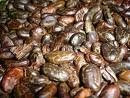
the dried beans


'Winnowing' is what we call the removal of a thin, useless shell.

Now the beans are ready to be ground into that precious "cacao liquor."

MAKING CHOCOLATE CHOCOLATE

From bean to bar, producing chocolate for eating is a complicated process.

Fat — cocoa butter — is removed to make it a dry
powder. It may be treated with alkalines, or “Dutched.”
This powder is the basis of cocoa.

'Cocoa' usually refers to that dry powder used to make a
hot, yummy chocolate drink or in recipes. Cocoa may be either
'dutched' or 'natural'.
chocolate - grounded cacao beans

Dutched cocoa has been treated with
an alkali to neutralize some of the acidity of chocolate.
It is darker in color than natural cocoa, but has a milder
flavor.

Fat is then returned to the cocoa, and sugar is added,
as well as other flavorings, such as vanilla. For milk
chocolate, of course, milk is added — either powdered,
condensed, or in small clumps.

The resulting mass is then 'conched.' This is a
grinding and mixing process that may go on for days and
produces the velvety texture of good chocolate. The earliest
conching machines used grinding stones shaped like conch
shells.

'Tempering' is a process used to keep chocolate from
developing 'bloom.' Bloom is those white spots found on
chocolate that has become too warm or too damp. It doesn't
hurt the chocolate for eating, but is not considered
attractive.

Happily, chocolate that gets 'out of temper' can be
melted and tempered again.

I love hot chocolate especially if its pure cocoa made from
cacao. We make it at home and it really is good. I love
munching them too. Cocoa/tablea is good in champorados too.
It tastes better than the commercial cocoa I bought and once
tried to eat or to put on my recipe, they don't just taste like
the natural cacao cocoa.

We really make our own chocolate, we do have cacao on our yard,
maybe atleast 20 trees. But I couldn't find the right words for
the process and terminologies used for these cacao parts without
reading something related to it. Which I mostly owed to
the book "The Chocolate Cupid Killings" by JoAnna Carl. It really
is an interesting book and of course, informative. Thanks JoAnna!!